

High-Strength Chromium-Molybdenum Alloy Steel Plates (EN 10083-3)
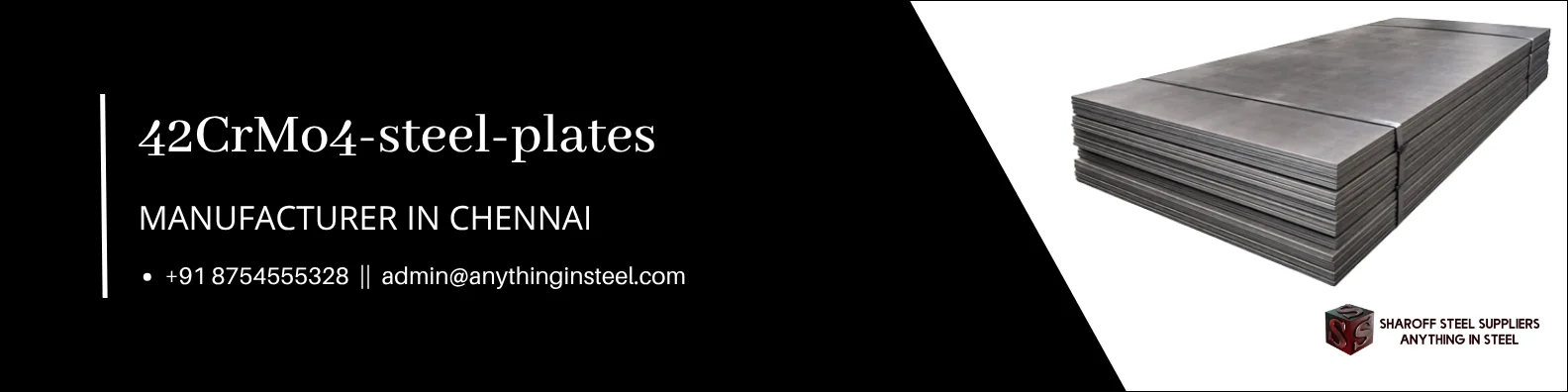
42CrMo4 steel plates are high-strength alloy steel plates supplied as per EN 10083-3, widely used in critical engineering, heavy machinery, and high-stress applications. This grade offers an excellent combination of strength, toughness, and hardenability, making it suitable for demanding service conditions.
At Sharoff Steel Suppliers, 42CrMo4 plates are supplied for projects where international standard compliance, mechanical performance, and reliability are non-negotiable.
42CrMo4 is a chromium-molybdenum alloy steel designed to deliver:
• High tensile and yield strength
• Excellent response to heat treatment
• Superior fatigue and impact resistance
• Stable performance under dynamic loading
It is the EN standard equivalent commonly specified in global engineering and EPC projects.
| Element | Typical % |
|---|---|
| Carbon (C) | 0.38 – 0.45 |
| Manganese (Mn) | 0.60 – 0.90 |
| Chromium (Cr) | 0.90 – 1.20 |
| Molybdenum (Mo) | 0.15 – 0.30 |
| Silicon (Si) | ≤ 0.40 |
| Phosphorus (P) | ≤ 0.035 |
| Sulphur (S) | ≤ 0.035 |
Exact limits depend on standard revision and mill practice. Always verify MTC.
| Property | Typical Value |
|---|---|
| Tensile Strength | 850 – 1100 MPa |
| Yield Strength | ≥ 650 MPa |
| Brinell Hardness (Q&T condition) | 248 – 320 HB |
• Confirms heat treatment quality
• Indicates suitability for high-load & fatigue-critical applications
• Guides machining parameters
• Reduces risk of in-service failure
| Aspect | EN19 | 42CrMo4 |
|---|---|---|
| Governing standard | BS / IS usage | EN 10083-3 |
| Global acceptance | Moderate | High |
| EPC / export use | Limited | Preferred |
| Mechanical consistency | High | Very high |
| Typical buyer | Domestic engineering | Global EPC / OEM |
42CrMo4 plates are selected when:
• Components face high cyclic or shock loads
• Design requires international EN compliance
• Heat treatment performance must be predictable
• Long service life is critical
This grade is widely used where failure is unacceptable.
Heavy Engineering & Machinery
• Press components
• Heavy shafts & couplings
• Load-bearing machined plates
Energy & Industrial Equipment
• Power transmission parts
• High-stress structural components
Automotive & Off-Highway
• Axles
• Drive components
• Forged and machined parts
42CrMo4 steel plates are commonly supplied as:
• Quenched & Tempered (Q&T) – ready for high-strength use
• Normalized – for further machining and custom treatment
Correct condition selection ensures performance + machinability balance.
Sharoff Steel Suppliers supplies 42CrMo4 steel plates in:
• Plates
• Cut-to-size blocks
• Machining-ready blanks
All supplies are accompanied by Mill Test Certificates (MTCs) as per EN standards.
Before ordering 42CrMo4 steel plates, confirm:
• EN 10083-3 compliance
• Plate thickness and dimensional tolerance
• Delivery condition (Q&T / Normalized)
• Required Brinell hardness range
• Impact test requirement (if any)
• MTC & inspection documentation
Clear specification avoids non-compliance and performance risk.
• Experience supplying EN-standard alloy steel plates
• Consistent mechanical properties and hardness control
• Cut-to-size supply for machining efficiency
• Clear differentiation between EN19 and 42CrMo4
We support buyers who require engineering confidence, not assumptions
Is 42CrMo4 the same as EN19?
They are chemically similar alloy steels, but 42CrMo4 follows EN 10083-3 and is preferred for EN-governed projects.
Can 42CrMo4 be welded?
Yes, but only with controlled pre-heating and post-weld heat treatment.
Is 42CrMo4 stronger than EN19?
Mechanical performance is similar, but 42CrMo4 offers tighter EN compliance and consistency.
42CrMo4 steel plates are a premium alloy steel solution for high-stress, safety-critical, and EN-governed engineering applications. Correct specification and supply condition are essential for achieving expected performance.
At Sharoff Steel Suppliers, 42CrMo4 plates are supplied with standards clarity, controlled quality, and procurement confidence.