


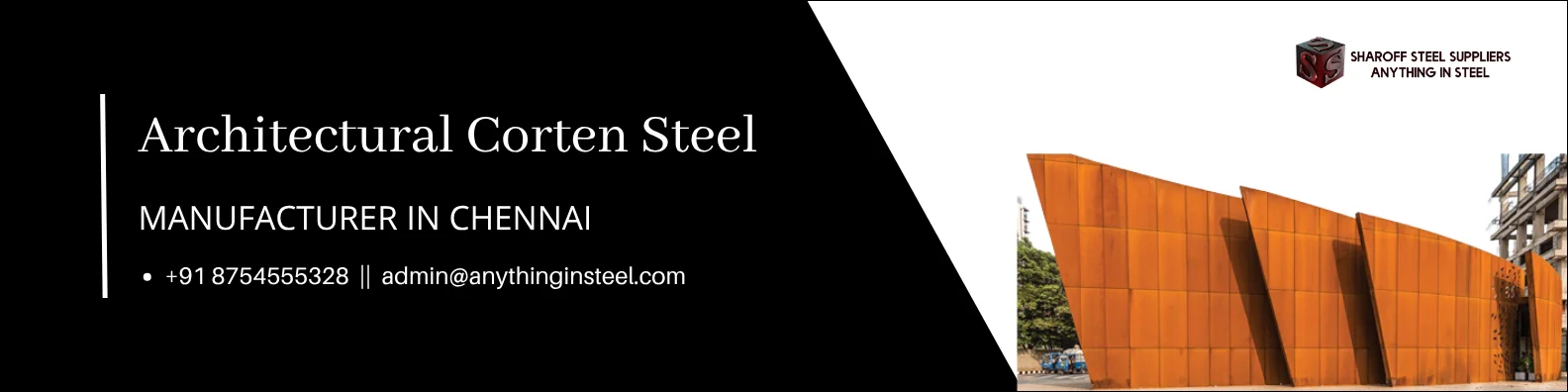
Weathering Steel for Architecture, Facades & Urban Design
Architectural Corten Steel is a corrosion-resistant steel widely used in facades, cladding, screens, sculptures, and urban architecture for its distinctive natural rusted appearance and long-term durability.
Unlike industrial or railway applications where corrosion resistance is the primary driver, architectural Corten is chosen for a combination of aesthetics, material honesty, and low-maintenance performance.
In architecture, Corten is valued not just as a steel grade, but as a visible surface material.
Key architectural characteristics:
• Natural rusted patina as the finished surface
• Evolving colour tones (orange → brown → dark umber)
• No need for external paint systems
• Texture and depth that change with light and weather
Architectural Corten is typically used where the steel is meant to be seen, not hidden.
Rectangular Hollow Sections (RHS)
• 1.2 – 2.0 mm → 40×20 to 100×50 mm
• 4 – 5 mm → 50×30 to 150×50 mm
• 6 – 8 mm → 100×60 to 250×150 mm
Square Hollow Sections (SHS)
• 1.2 – 2.0 mm → 20×20 to 60×60 mm
• 4 – 5 mm → 30×30 to 100×100 mm
• 6 – 8 mm → 100×100 to 200×200 mm
Circular Hollow Sections (CHS / Pipes)
• 1.6 – 6.0 mm thickness
• OD range: 25 mm to 250 mm
Custom lengths and cut-to-size supply available.
Architectural Corten is usually supplied using thinner sections of:
• CORTEN-A
• EN 10025-5 S355J2W+N (thin gauges)
• JIS SPA-H
• Equivalent weathering steel grades
Grade choice depends on:
• Thickness required
• Local availability
• Design codes and approvals
Architectural applications usually use thin to medium thicknesses:
• 1.6 mm – 4 mm → Facade panels, screens, cladding
• 5 mm – 6 mm → Louvers, fins, sun-shades
• 8 mm – 12 mm → Feature panels, sculptures, signage
Thickness selection affects:
• Visual depth
• Warping resistance
• Patina development
Building Facades
• External cladding systems
• Rainscreens
• Ventilated facade panels
Urban & Landscape Design
• Screens and partitions
• Public art installations
• Street furniture
Architectural Features
• Louvers and fins
• Staircases and railings
• Canopies and pergolas
Architectural Corten develops a protective rust layer over time when exposed to alternating wet and dry conditions.
Key points designers should note:
• Patina development varies with climate
• Initial runoff may stain adjacent surfaces
• Full stabilisation typically takes several months
• Controlled pre-weathering is sometimes used
Design detailing is critical to manage runoff, drainage, and staining.
Architectural Corten requires different detailing discipline compared to painted steel:
• Avoid water traps and closed sections
• Provide clear drainage paths
• Allow for thermal movement
• Consider edge detailing and joint visibility
• Plan for runoff protection on adjacent materials
Good design ensures the steel ages gracefully, not unpredictably.
Architectural Corten may be supplied as:
• Mill finish (natural weathering on site)
• Pre-weathered / accelerated rusted finish
• Sealed or stabilised patina (on request)
Finish selection depends on aesthetic intent and project timeline.
• Understanding of architectural thickness ranges
• Supply of suitable weathering grades for visible applications
• Guidance on design and fabrication considerations
• Ability to support architects, fabricators, and facade consultants
We help architects design with Corten confidently, not experiment blindly.
Is architectural Corten different from industrial Corten?
The material grade may be similar, but thickness, finish, and detailing requirements differ significantly.
Does architectural Corten stain surrounding materials?
Yes, during initial weathering. Proper detailing and drainage prevent permanent staining.
Can architectural Corten be sealed or stabilised?
Yes. Sealers can be applied once the patina stabilises to reduce further runoff.
Is architectural Corten suitable for Indian climates?
Yes, when detailed correctly. Climate influences patina speed and colour variation.
Can architectural Corten be used indoors?
Yes, primarily for aesthetic features where controlled rust appearance is desired.
Architectural Corten Steel is a material chosen as much for visual expression as for durability. When detailed and specified correctly, it delivers a timeless, low-maintenance architectural finish that improves with age.
At Sharoff Steel Suppliers, architectural Corten is supplied with design-aware guidance, helping projects achieve the intended aesthetic without technical compromise.